
Managing Forests in a Changing Climate

A few months ago I was asked to update a forest management plan for a client I've worked with for the past 25 years. They are a great client. They listen to advice, are motivated by forest health, and want to do the right thing for the forest. Their forest is also in great shape. It makes management a lot less challenging.
Their current plan is about 15 years old, and due for a refresh. I am thinking more about climate change these days, more so than I when I wrote their first plan. But would I know climate change if I saw it? And if so, how would it affect plan writing?
One place climate change is showing up is in winter logging conditions. The client owns forests in the northern US, and all timber harvests are conducted in winter when soils are frozen. Over the past several years, there have been mid-winter thaws, requiring a shutdown of logging operations. It has not been too disruptive so far, but it does call into question whether frozen ground restrictions on logging will remain viable in the future. It also appears in some years that sawtimber-sized red pines appear stressed, but I don’t know if that reflects climate stress or something else.
One leading framework for managing forests for climate adaptation is called the resistance-resilience-transition model. The approach embraces uncertainty during forest management planning. It does this by by being explicit about different adaptation strategies, approaches and tactics. Resistance refers to actions and activities that improve the defenses of the forest against anticipated change,. The goal is to defend the forest against disturbance, maintaining unchanged conditions. Resilience emphasizes actions and activities that accommodate some degree of change, but allow for a return to a range of desired reference conditions after disturbance. Lastly, transition embraces actions and activities that intentionally accommodate change, enabling the forest to adaptively respond to changing conditions. Treating small groves of hemlock with imidacloprid to protect it against hemlock wooly adelgid? That’s a resistance strategy. Including southern red oak seedlings as part of the species mix during reforestation efforts? That’s a transition strategy.
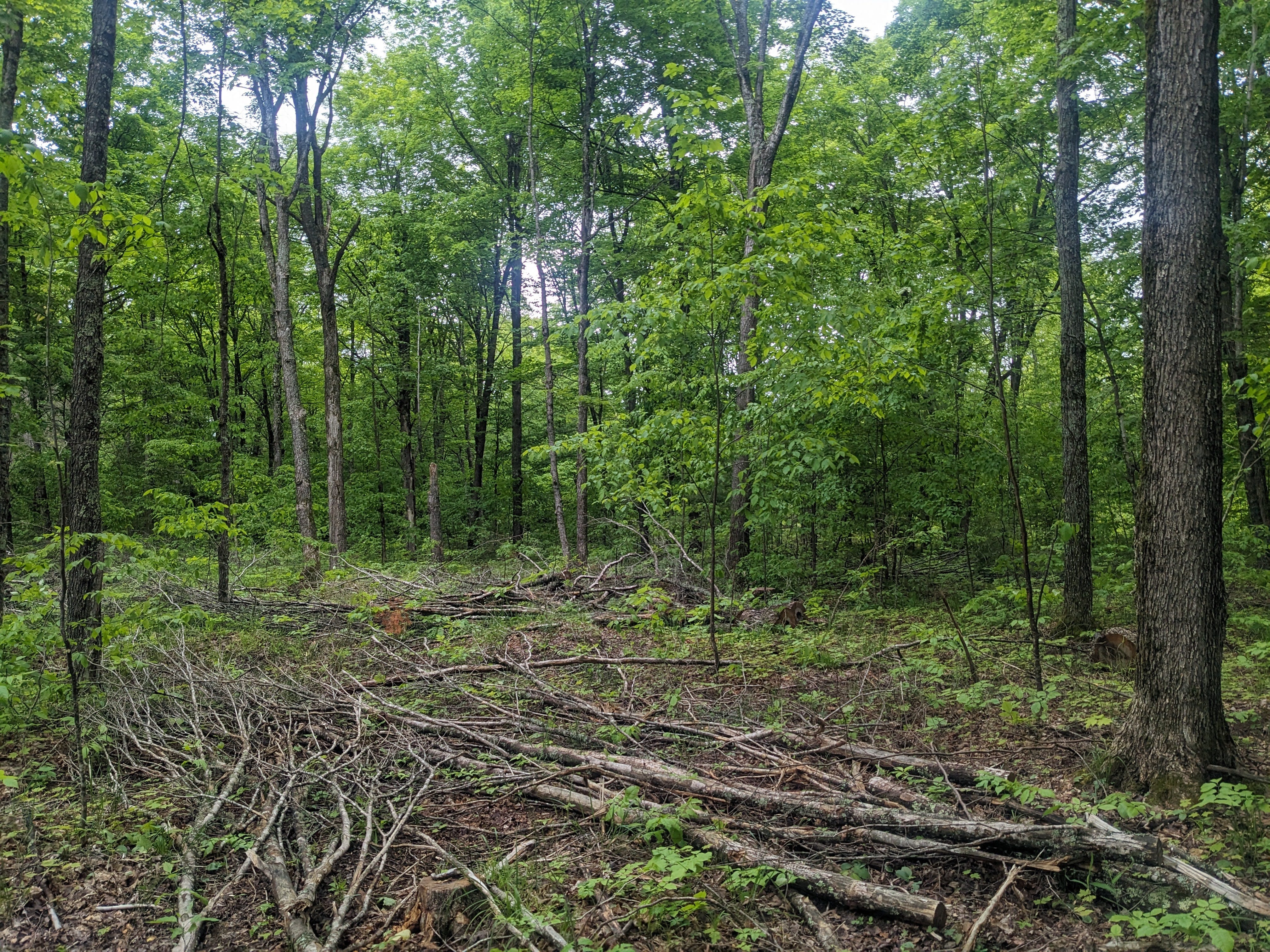
The primary driver of rapid change in our forests in this part of the world is not climate, but invasive species. For the past two years, we have been harvesting white ash trees, ahead of emerald ash borer. This harvest pattern has produced an interesting structure in the forest. Because white ash occurs sometimes as individual trees, and sometimes in small groups, the post harvest pattern reflects what you might get with the ICO method. ICO stands for individuals, clumps, and openings. This technique is primarily used for reducing wildfire risk and restoring dry forests in the western US. The primary effect is an increase the amount of horizontal structure in the stand. Researchers believe that structural complexity contributes to the adaptive capacity of forests. I’m sure it does, in some contexts, and in some places. But lots of unknowns remain.
I’m thinking a lot about using the ICO method as an alternative to traditional thinning from below. ICO has a dial. In western forests, you can dial up the ICO intensity and remove more trees to reduce fire risk. In eastern hardwoods, you can dial down ICO intensity and remove fewer trees, since catastrophic wildfire risk is lower. I’m not suggesting we abandon traditional thinning activities and replace them with ICO. This is another tool in our toolbox that could help meet landowner objectives. I’ll be watching these ICO-managed stands over the coming years to see what lessons they might hold.
As I start to draft a plan revision, I’m thinking about what kinds of change to expect over the next 15 years or so, and how that might affect identifying reasonable desired future conditions. My client would like nothing better than a plan deeply rooted in resistance strategies, but they realize no amount of management was going to prevent the loss of white and black ash from their forest. I’m thinking more along the lines of resilience strategies. I find myself trying to lean into complexity, in the hopes that it provides some of the adaptive capacity needed in a changing climate. Prescriptions will involve retaining stand legacy trees and dead wood, while using thinning and small openings across stands. These activities are designed to increase complexity and promote desirable species that respond well to disturbance. In this shift from resistance to resilience, we will focus less on maintaining existing species composition and structure, and more on withstanding and responding adaptively to disturbances that can or will occur outside of the management window.
The key professional challenge of climate change, at least in my mind, is that a novel future environment undermines the reliability of our past experience. Things that worked well in the past might not continue to do so in the future, and we won’t know that until attempts fail. Now, more than ever, I’m looking at each timber harvest as an experimental intervention that will produce expected and unexpected results. My university days may be far behind in my rear view mirror, but these days I’m still in the classroom, learning directly from the forest.